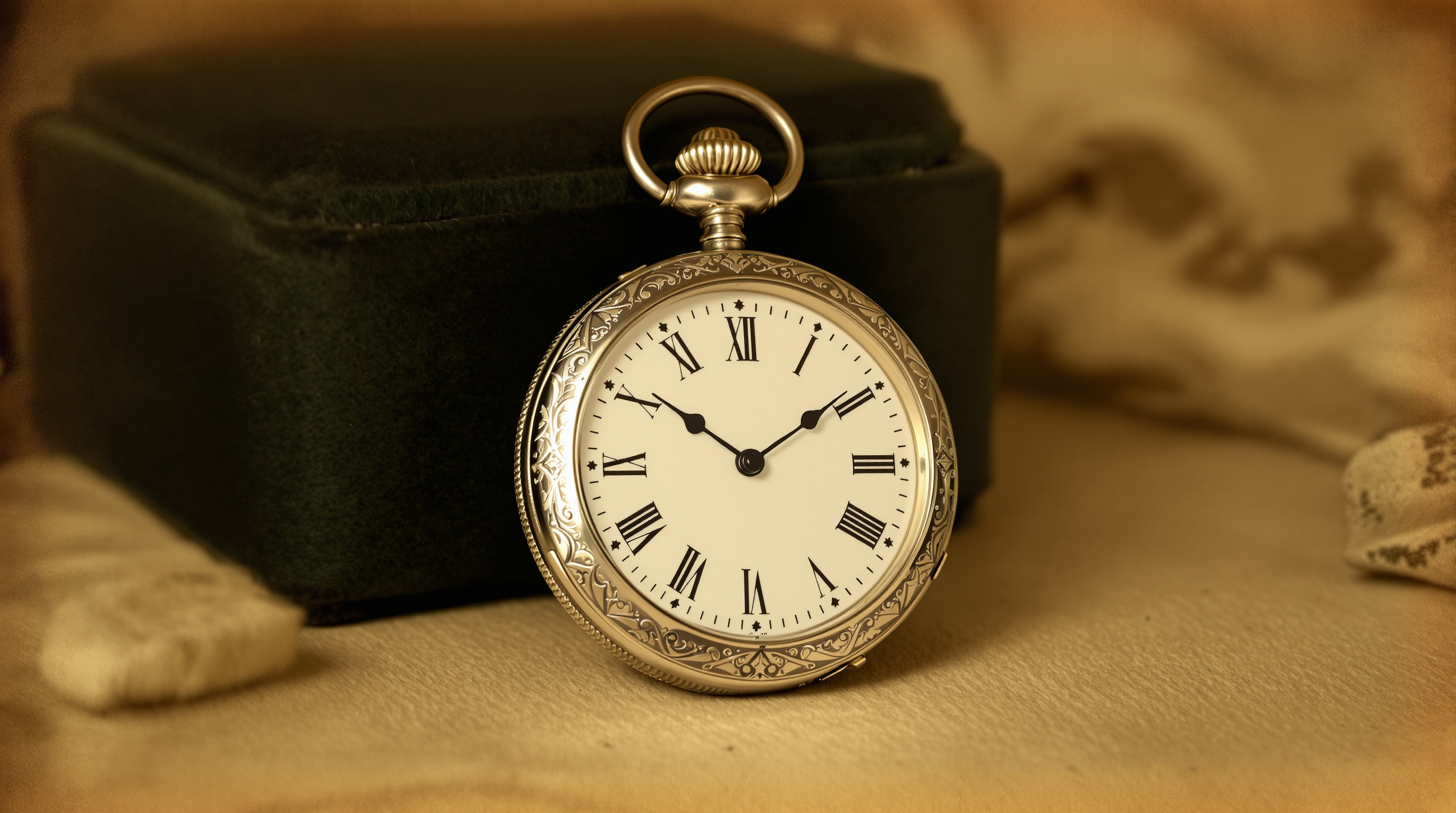
The history of the watch is, in many ways, the history of precision itself. The imperative to measure time accurately — for navigation, for commerce, for science — drove successive generations of craftsmen to ever-greater feats of miniaturisation and mechanical ingenuity. The modern luxury watch is the product of five centuries of accumulated knowledge.
The Age of the Pocket Watch (1500s–1900s)
The earliest portable timepieces emerged in the early sixteenth century, credited variously to craftsmen in Nuremberg and Blois. These “Nuremberg eggs” — small, elongated cases housing spring-driven fusee movements — were curiosities of the very wealthy. Their accuracy was poor by any modern standard, typically displaying only a single hour hand.
The introduction of the balance spring (or hairspring) around 1675 transformed portable horology. By providing a returning force to the balance wheel, the spiral spring enabled a resonant oscillator with far greater isochronism. Accuracy improved from losing or gaining hours per day to minutes. The lever escapement, developed around 1755, provided the stable, efficient mechanism that would dominate watchmaking for the next two-and-a-half centuries.
The Birth of the Wristwatch (1880s–1910s)
The transition from pocket to wrist was driven by practicality. Military officers in the late nineteenth century recognised that consulting a pocket watch while managing troops was impractical. Early wristwatches — essentially pocket watch movements strapped to the wrist — appeared in Brazilian and European military records from the 1880s.
The Boer War and, more decisively, the First World War normalised wristwatch wearing for men across European and American society. By 1930, the wristwatch had overtaken the pocket watch in commercial importance, inaugurating the format's century-long dominance.
The Golden Age (1920s–1960s)
The interwar period produced some of the most celebrated watch designs in history. Art Deco aesthetics — geometric shapes, architectural dials, contrasting material combinations — informed case and dial design across the industry. The period also drove critical technical advances: anti-magnetic materials, improved water resistance through screw-down innovations, and the commercial realisation of the automatic rotor movement.
The 1950s and 1960s brought professional watches to prominence — divers' instruments, pilot chronographs, and field watches designed to perform under operational conditions. The engineering purpose of these pieces is legible in every design element, giving them a coherence that purely decorative watches of the era cannot match.
The Quartz Crisis (1969–1984)
The commercialisation of the quartz wristwatch, beginning in December 1969, was the most disruptive event in the watch industry's history. Japanese manufacturers introduced battery-powered quartz watches at price points and accuracy levels that mechanical watches could not match on practical grounds. Swiss exports collapsed. Thousands of watchmakers lost their livelihoods. Venerable brands disappeared or were absorbed into conglomerates.
Recovery came from an unexpected direction. In 1983, engineer Nicolas Hayek launched the Swatch — a low-cost plastic quartz watch that competed directly with Japanese products on price while offering Swiss design cachet. The Swatch Group used revenues from this mass-market operation to sustain and ultimately revive the mechanical watch division, repositioning Swiss mechanical watches as luxury artefacts rather than utilitarian instruments.
The Mechanical Renaissance (1985–Present)
The late 1980s and 1990s saw a dramatic reassessment of the mechanical watch. No longer competing on accuracy or price, Swiss manufacturers leaned fully into craft, complication, and heritage. Independent watchmakers established ateliers producing movements of extraordinary quality in tiny volumes, reestablishing the pre-industrial ideal of the watchmaker as sovereign artisan.
The contemporary luxury watch market sells mechanical devices whose primary function is performed better by a ten-dollar quartz movement, yet commands premiums that few other manufactured objects justify. The explanation lies precisely in this paradox — the value of a mechanical watch is its human origin. For the horological scholars who study this craft, the mechanical watch represents one of humanity's most enduring expressions of precision as art.