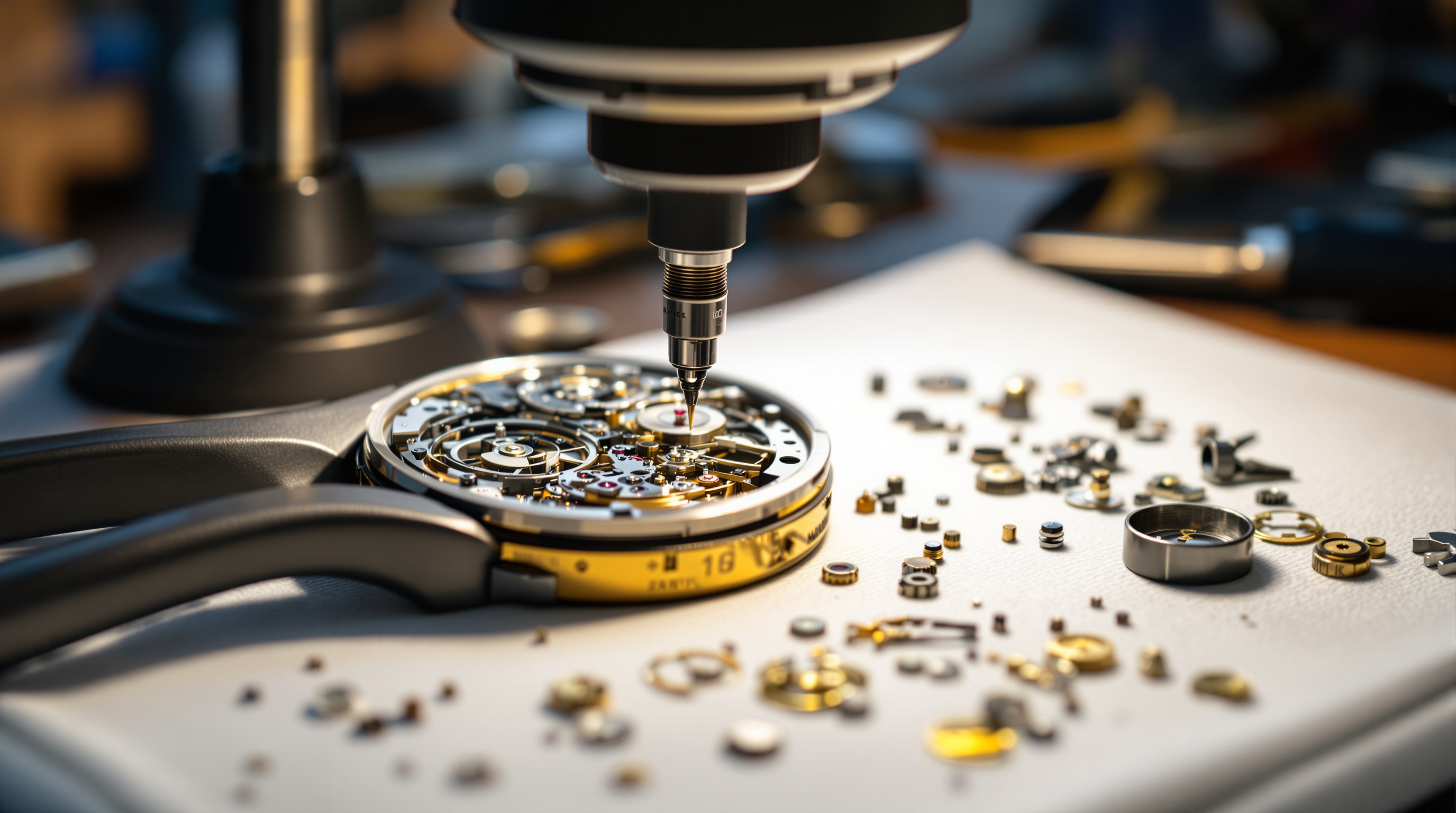
A luxury mechanical watch, properly maintained, will outlive its owner. The mechanisms inside a fine calibre are extraordinarily robust — many vintage watches from the mid-twentieth century are still performing accurately today, a century after their creation. But robustness is not immunity: without appropriate care and periodic servicing, even the finest movement will eventually degrade.
Servicing Intervals
The traditional recommendation for mechanical watch servicing was every three to five years — driven by the lubricant chemistry available in earlier eras. Modern synthetic lubricants maintain their properties considerably longer, and leading manufacturers now recommend service intervals of eight to ten years for their contemporary calibres.
Early signs of a lubricant in need of replacement include a watch running significantly fast or slow compared to its normal rate, erratic rate variation across positions, or a power reserve noticeably shorter than its specification. For vintage movements, a five-year interval remains prudent.
Understanding Water Resistance
Water resistance ratings are commonly misunderstood. The designation “30m water resistant” does not mean a watch is suitable for swimming at 30 metres depth — it means the watch was tested to resist water ingress at static pressure equivalent to 30 metres at the time of manufacture. Dynamic pressure from swimming is considerably higher, and gaskets deteriorate over time.
- 30m / 3ATM — Splash and rain resistant only. Not suitable for swimming.
- 50m / 5ATM — Suitable for brief swimming. Not diving or snorkelling.
- 100m / 10ATM — Suitable for swimming and snorkelling. Not diving.
- 200m+ / 20ATM+ — Suitable for recreational scuba diving.
- 300m+ — Suitable for saturation diving with appropriate helium escape valve.
Have your watch's gaskets inspected and replaced as part of each service, and consider annual water resistance testing if the watch is worn in aquatic environments.
Safe Storage Practices
When not being worn, watches are best stored in controlled conditions: stable temperature (ideally 15–25°C), moderate humidity (40–60%), away from direct sunlight and strong magnetic fields. Extreme temperature fluctuations stress lubricants and gaskets; UV light fades dials; magnetic fields — produced by laptop computers, speaker systems, and some bag closures — can magnetise the balance spring, causing severe rate errors that require demagnetisation to correct.
Preventing Common Damage
The majority of damage to luxury watches falls into predictable categories. Sapphire crystals resist scratching from most everyday materials but can be cracked by hard impacts; mineral glass scratches more readily but can be polished. Crown damage is among the most common mechanical failures — forcing a screw-down crown without first unscrewing it fully strips the thread.
Leather straps should be rotated regularly to prevent moisture saturation and cracking; metal bracelets benefit from occasional ultrasonic cleaning at a watchmaker's. Replace bracelets and straps on schedule rather than waiting for them to fail.
When to See a Watchmaker
Several symptoms warrant prompt attention: a watch running more than 30 seconds per day outside its rated accuracy, condensation visible under the crystal, an unusual clicking or grinding sound from the movement, or a crown that no longer feels solid. None of these resolve themselves. The British Horological Institute and the American Watchmakers-Clockmakers Institute both maintain directories of certified practitioners.