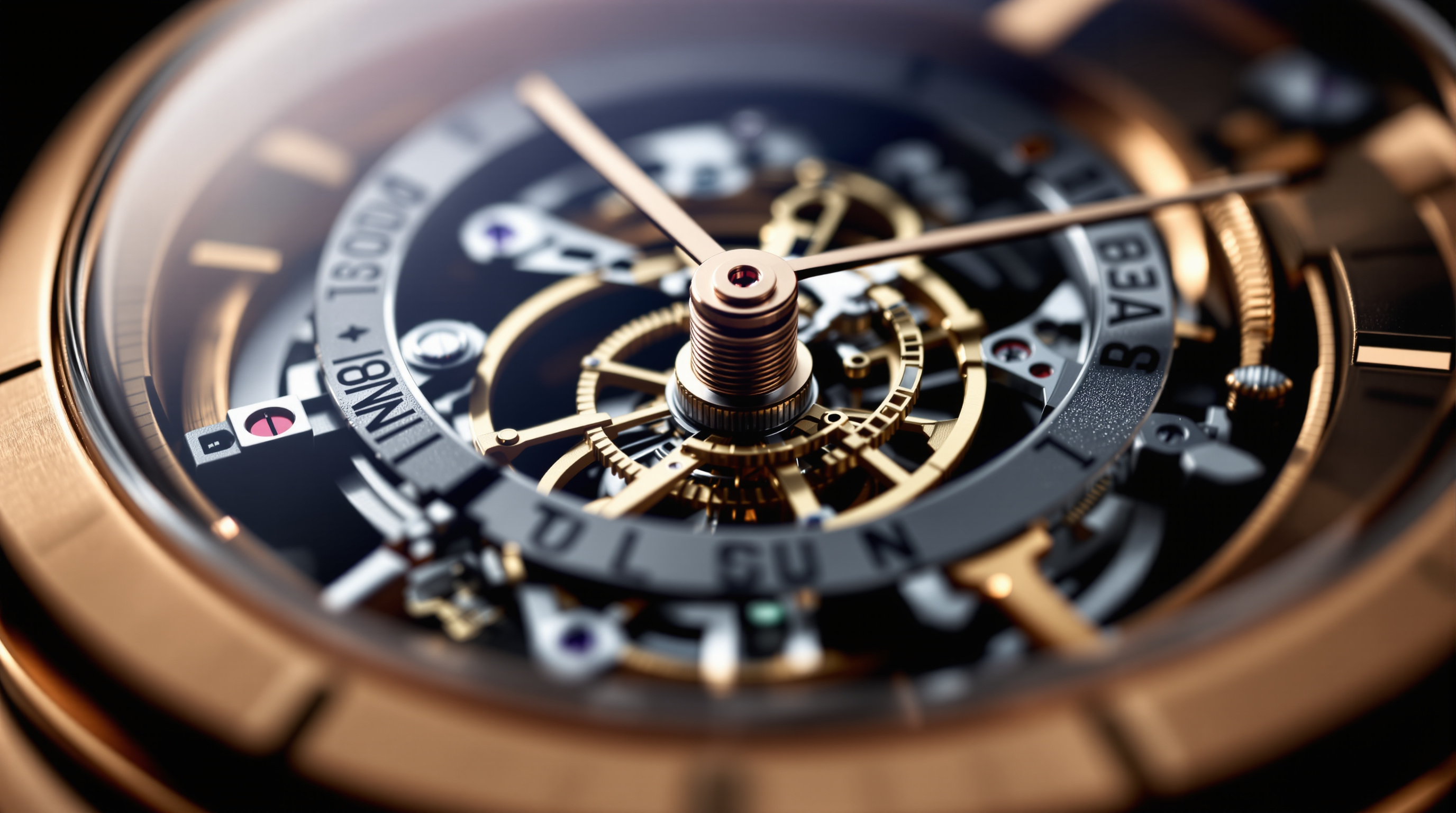
In horological terminology, any function beyond the simple display of hours and minutes is called a complication. The term carries no pejorative sense — rather, complications represent the ingenuity of watchmakers who were never content with merely telling the time. From the useful to the spectacular, they reveal the full creative range of fine watchmaking.
The Chronograph
The most commercially popular complication, the chronograph adds an independent seconds-counting function — essentially a stopwatch — to the base timekeeping display. A pusher at 2 o'clock starts and stops the elapsed-time mechanism; a pusher at 4 o'clock resets it to zero. More refined flyback chronographs reset and immediately restart the timer with a single push.
Chronograph mechanisms are classified by their construction. Column-wheel chronographs offer a lighter, crisper push-button action than cam-lever equivalents. Vertical clutch chronographs eliminate the jump of the seconds hand at the moment of engagement — a subtle but appreciable refinement visible to attentive observers.
The Perpetual Calendar
The perpetual calendar movement automatically accounts for months of different lengths — 28, 29, 30, and 31 days — without requiring manual correction. Most perpetual calendars account for the four-year leap year cycle, requiring no adjustment until 2100 (when the Gregorian calendar skips its usual leap year).
The mechanism accomplishes this through a system of cams and levers driven by the gear train, programmed with the full Gregorian cycle. Annual calendar variants, which require a single yearly correction at the end of February, offer a practical middle ground between simple day-date and the full perpetual.
The Tourbillon
Invented by Abraham-Louis Breguet in 1801, the tourbillon (French: whirlwind) places the escapement and balance wheel in a rotating cage that completes one revolution per minute. The purpose was to average out positional errors caused by gravity acting unevenly on the balance wheel in a pocket watch's predominantly vertical position.
In the modern wristwatch context, the tourbillon's practical benefit is disputed. What is not disputed is its visual drama and the extraordinary skill required to produce it: a tourbillon cage containing some 70–80 individual components must weigh less than 0.3 grams. The tourbillon remains the supreme demonstration of watchmaking virtuosity.
The Minute Repeater
Before electric lighting, knowing the time in darkness was a significant luxury. The minute repeater addresses this by chiming the time on demand: press a slide on the case and the watch sounds the hours, quarter-hours, and minutes in sequence using two or more tuned gongs. A calibre striking 12 hours, 3 quarters, and 14 minutes produces 29 strikes in rapid succession.
The quality of a minute repeater's chime — its clarity, resonance, and the accuracy of its tuning — is as much an acoustic as a mechanical achievement. Watchmakers test the timbre of their gongs against a piano or tuning fork, adjusting until the sound is deemed worthy. Few complications require such multi-disciplinary mastery.
The GMT Function
Developed in collaboration with Pan American World Airways for transatlantic pilots and crew in 1954, the GMT complication displays a second time zone via an additional hand pointing to a 24-hour bezel or scale. True dual-time GMT movements allow independent adjustment of the local hour hand without disturbing the minute, seconds, or home-time display.
The Moon Phase
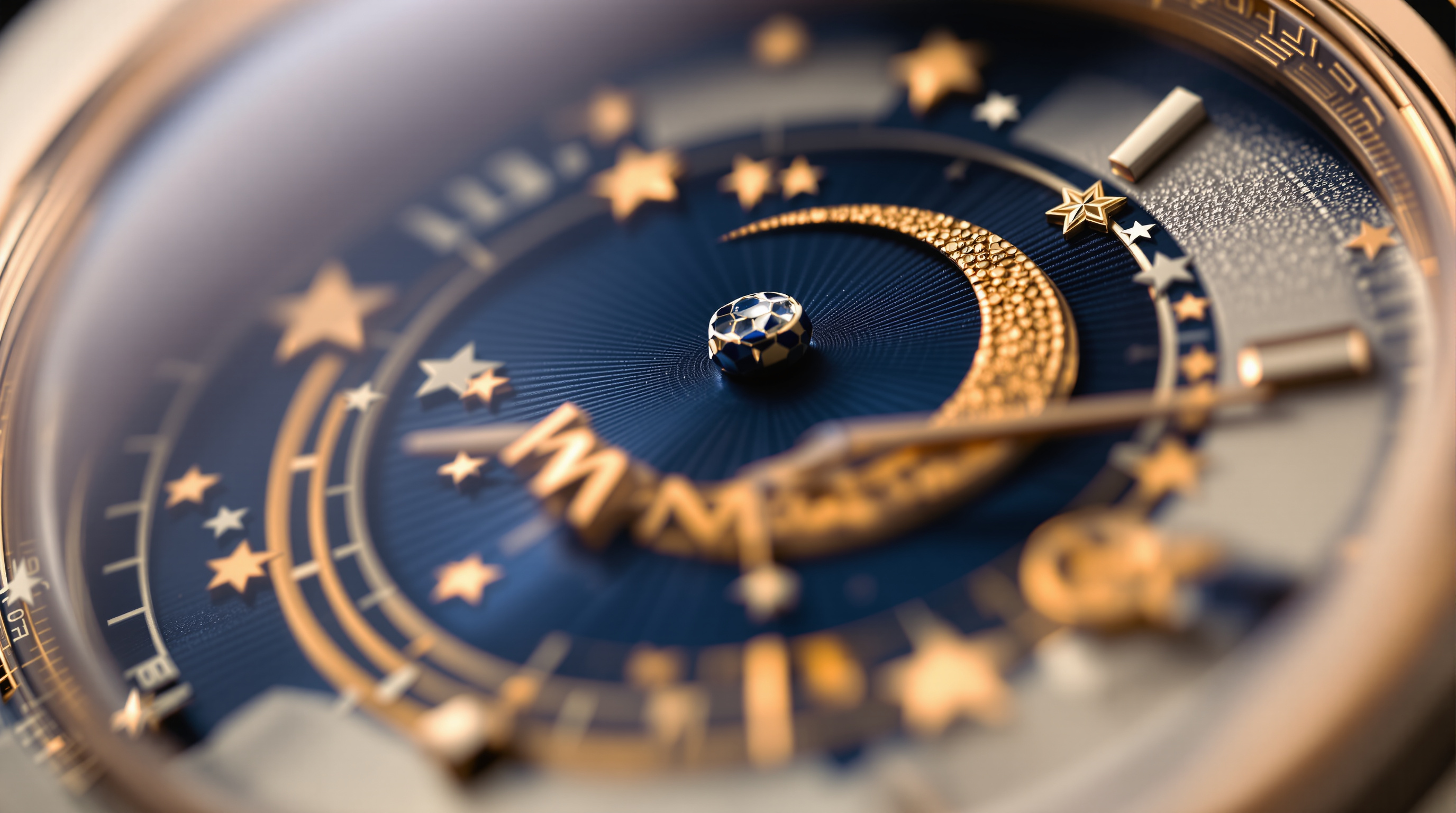
Romantic and visually captivating, the moonphase displays the current phase of the lunar cycle through an aperture in the dial. A disc printed with two moon images rotates beneath the dial, driven by a 59-tooth gear advanced once per day. The standard mechanism accumulates an error of approximately one day every 2.7 years.
Higher-precision moonphases employ a 135-tooth gear that requires correction only once every 122 years. The Antiquorum auction house catalogues historic examples of moonphase complications spanning three centuries of watchmaking.