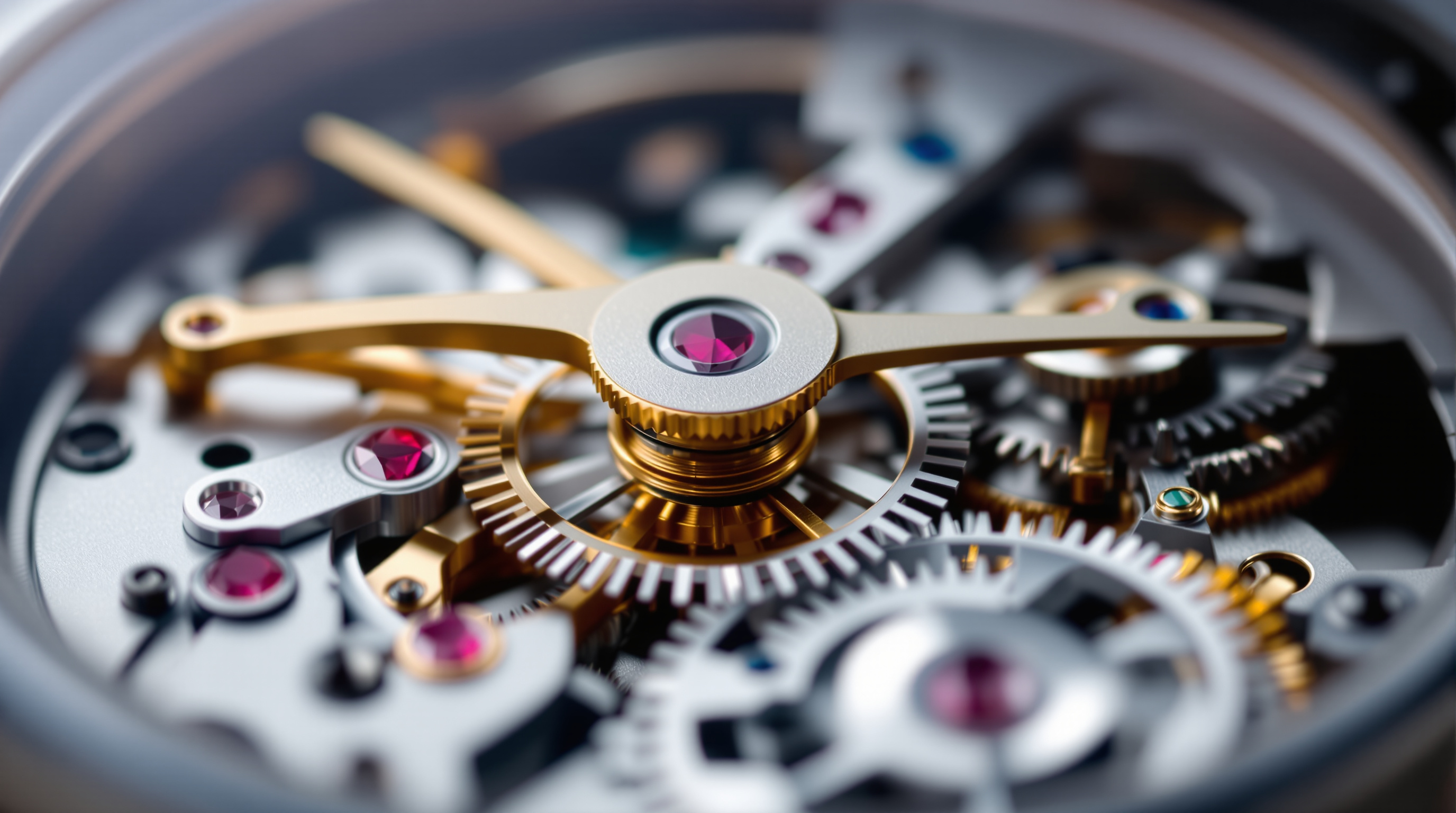
The movement — or calibre — is the engine of a watch. It is the assemblage of dozens to hundreds of individual components, each machined to tolerances measured in microns, that together accomplish the remarkable feat of dividing a day into equal, measurable parts. Understanding movements transforms the way you look at every watch on your wrist.
Manual-Wind Movements
The original mechanical movement, the manual-wind calibre requires the wearer to periodically wind the mainspring by rotating the crown. A fully wound mainspring stores enough energy to power most calibres for 40 to 72 hours, depending on the movement's complexity and the efficiency of its gear train.
The ritual of winding is, for many collectors, part of the appeal. Each morning you engage with your watch, feel the click of the ratchet, observe the crown turning against light resistance as the spring coils — and you are reminded that this instrument is entirely mechanical, requiring no battery, no signal, no external infrastructure.
Fine manual movements often feature elaborate finishing: côtes de Genève striping on bridges, bevelled and hand-polished anglage on edges, and circular graining (perlage) on plates. These touches, invisible under normal wear, represent dozens of hours of artisanal work and distinguish a true manufacture calibre from a generic ébauche.
Automatic Movements
In 1923, watchmaker John Harwood patented the first self-winding wristwatch mechanism, employing a rotating weight — the rotor — that swings freely on a pivot and transfers energy to the mainspring with each movement of the wrist. The automatic movement was born, and it remains the dominant form of mechanical watchmaking today.
Modern automatic calibres use bi-directional winding systems, allowing both clockwise and counter-clockwise rotor rotation to contribute to the mainspring. The most sophisticated incorporate micro-rotor designs — with the rotor integrated into the movement plate itself rather than sitting above it — allowing for slimmer overall case heights.
Power reserves of 42 to 80 hours are standard, though certain movements with oversized barrels or multiple barrels achieve 7-day reserves. Most contemporary automatic movements include a stop-seconds mechanism (also called hacking), allowing the seconds hand to be halted for precise time-setting.
Quartz Movements
The quartz oscillator, first commercialised in the late 1960s and mass-produced from 1969 onward, revolutionised — and nearly destroyed — the Swiss watch industry. Where a mechanical lever escapement typically oscillates at 6 to 10 beats per second, a quartz crystal vibrates at precisely 32,768 times per second. The result is extraordinary accuracy: most quartz movements deviate by fewer than 15 seconds per month.
High-end thermocompensated quartz movements monitor ambient temperature and adjust the oscillator frequency accordingly, narrowing deviation to a few seconds per year. In the contemporary luxury market, quartz movements are associated with dress watches where slenderness and long-term precision are prized.
Co-Axial and High-Frequency Escapements
The escapement is the mechanism that releases energy from the mainspring in controlled, equal increments — it is what produces the characteristic tick of a mechanical watch. The traditional lever escapement, dominant for over 250 years, requires lubrication to function smoothly. Lubricants, however, degrade over time and necessitate periodic service.
The co-axial escapement, invented by independent watchmaker George Daniels and adopted commercially in 1999, dramatically reduces the sliding friction in the escapement, extending service intervals from the traditional 3–5 years to 8–10 years or more. High-frequency movements — operating at 36,000 vibrations per hour rather than the standard 28,800 — improve resistance to positional variation and shock.
How to Read a Movement
When you turn a watch over and look through its sapphire caseback, several elements reveal the calibre's character. The quality of finishing — how bridges are bevelled, whether screws have polished slots, how the rotor is decorated — speaks to the manufacture's standards. The number of jewels (synthetic rubies used as friction-reducing bearings) indicates complexity: a basic calibre uses 17 jewels; a chronograph adds another 10–15.
For deep technical reference, the WatchBase database catalogues specifications for thousands of movements across manufacturers and eras — an invaluable resource for collectors researching specific calibres.